
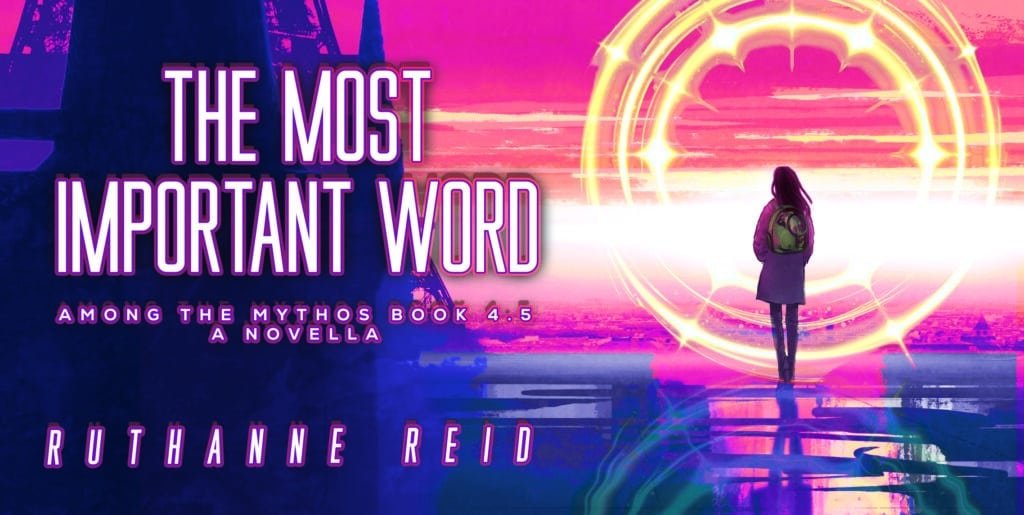
THE WORLD? ENDING. THE ESCAPE? MAGIC PORTALS. THE COST? EVERYTHING.
Amber Moore has screwed up a lot in her life. She’s due a win, and maybe this is it: a magic portal to lands unknown, created and run by fairy-tale monsters. As far as she’s concerned, survival is a decent trade for her freedom—but servitude is not what she finds.
Étienne is sad. Handsome. Lonely. Also, a vampire… and she is determined to befriend him, finding hope for them both. In the middle of an apocalypse complicated by curses, beauty, and unexpected romance, what difference can one woman’s choices make? As it turns out, all the difference in the world.
Related Short Story: They Come
Amazon | Apple | B&N | Kobo | Smashwords | Itch.io | Other Stores

CHAPTER ONE: CHOICE
The end of the world was weirdly quiet, not with a bang, or even a whimper, but a simple cessation of mechanical noise. No cars or sirens, no whirring fans or distant gunshots. No planes overhead or echoing bang of garbage trucks making the rounds.
As if in solidarity, dogs stopped barking—or, Amber thought, maybe they’d just all been eaten.
No, the only sound, like a lone voice, was the wind—mourning the deaths, the loss, the future. That was not a great thought to have, though, not exactly the kind of thing that prompted one to take a shower and brush one’s hair and do morning stretches, so Amber tried to think about something else.
She replayed her last conversation with her mother one more time (which was probably one time too many for mental health), and reassured herself they’d both said the important thing: I love you.
They wouldn’t get to say it again. They probably wouldn’t see each other again, either. Right around the time the phones stopped working, Amber realized there was no way to travel from Georgia to Wisconsin and survive. Not with roving gangs of mutated shape-changers stuck between animalistic forms and rending the living. Not with shambling hordes of silent corpses, which apparently existed only to bite people and make sure their corpses rose, too.
I love you. Maybe the only words that mattered, here at the end of the world.
As to what had ruined the world, she’d never learned. When news was still being broadcast, theories were all over the place, though the general consensus was it had to be some kind of biological warfare. Whatever the cause, the news also said that the non-human Peoples had offered some kind of asylum—servitude, or something—in exchange for rescue. For survival.
Amber wasn’t the only person to say screw that. Three months ago, that opinion had been easy.
Three months ago, the phones still worked, and she could talk with her mom, and her friends, and they could rile one another up with fear then make each other laugh to get through it. Now, there were no working phones. There was no running water. There was streaking sky-bleed, broad daylight turned dim and violated by claw-like marks in virulent purple. There were enormous dark shapes that seemed to be walking through buildings too far away to clearly see. There were roving purple clouds of sparkling horror, transforming anyone they touched into mutants.
Someone will come, she’d told herself. The government, or a plucky band of adventurers, or maybe even her friends armed with homemade spears. Someone.
No one did. She was almost out of bottled water. And when she noticed purple mold lingering in the corners of her apartment—mold the same color as the weird, hungry fog—she knew she had to leave.
Servitude was better than starvation, better than infection, better than any of the fates that awaited her if she did nothing at all, and so Amber went to dig her salvation out of the trash.
The paper she rescued was wrinkled, smelly, and stained. That was because after she’d copied down the information from the news, chided herself for panicking, crumpled it up, and thrown it away. It had sat for weeks in a plastic bag no one would pick up, moldering under discarded egg shells and rotted orange peels. Not her best move.
Lots of her moves were not her best move. Letting high school friends drag her into unwise narcotics use (and then losing those friends when she went clean), earning a degree in art preservation (which meant working in a print shop while carrying student debt), adopting a dog she couldn’t care for (and had to give up), keeping even local friends at arm’s length (which meant if they were in a plucky band of adventurers, they likely wouldn’t come for her), moving so far away from home—
No, she didn’t regret Decatur. But that was the only thing, honestly, she’d done right. Well. That and adopting her old Siamese, though she was running out of food for him, too.
Maybe she was due a win. By some miracle, the note was still legible. She still copied it onto a clean piece of paper before digging up a paper map her mother had insisted she keep, and planning out her route.
She’d either make it there, or die on the way. Staying here, she would die. It wasn’t much of a choice.
Fortunately, she still had some pet-safe sleepy pills from her move, and used that to smuggle Kitty into the pet-safe backpack she used to take him places. Then bundling herself, wrapping up and masking up and taking her kitchen knives, she wore her “kick-ass boots” (the ones with steel toes) and stepped helplessly into the world.
It took her six and a half hours to cross the city she’d come to call home—this humid, haughty, historied place, with its Carnegie-funded library and octagonal Transfer House and its name from a hero in the War of 1812. She loved it, and wept as she walked (making both scarf and mask very damp), wishing she could tell it she loved it, too, but it was dead. Whatever soul this city held had long ago fled. She couldn’t tell it anything.
Too late, like so much of her life, her chances and choices both. Dead.
It was harrowing; mutant shape-shifters roved in packs, and their claws fortunately made such sound on the cracked concrete that she had time to hide. The purple mist, she could see, and thus avoid. The shambling corpses were slow, so she could dodge them, too. It was still six hours of hot and humid hell, breathing hard and trying not to, adrenaline high, feeling shaky.
She drank her last bottle of water, checked on Kitty (who was, fortunately, still asleep), and then, exhausted, soaked through, she found the address location. The portal was in… a church? Sure enough: an old church in old Decatur, some kind of faux-gothic style with a rose window too big for its facade. All around was ruin—crushed bricks and broken timber, wires sticking out like stingers—but the church itself was pristine. The large wooden door, a flaking red, was wide open, and the entryway flickered subtly with a green glow she somehow felt she’d never seen before in her life.
Her stomach twisted as she stepped through and magic danced over her skin like electricity and feathers. Someone had been here recently; lit candelabras swung gently over the empty nave, and the air smelled clean, without rot or burning chemicals or strange ozone smells. Realization slammed into her: for the first time in her life, she was seeing magic.
She’d never seen magic in person. There were plenty of videos and reports and studies, and she knew it was real, but it had never crossed her path. Why would it? Humans couldn’t use it; and this inaccessible mystery was what she was hurling herself toward, hoping for succor.
Trading her freedom for survival. Benjamin Franklin could go eat himself, because he hadn’t had to face zombies.
Amber had assumed the portal would be where the altar normally stood, but it wasn’t. Instead, it was to the right, in a transept (which knowledge marked the first time she’d used her degree). Swirling green and darkness, a hole to nothing, ten feet in diameter and silent, the portal hovered in the gloom, alien and unguarded. Beside it stood a polite little lectern with a single sheet of laminated paper reflecting the candlelight.
If that page was a spell, she was in trouble. Swallowing hard, Amber craned, peering, and found terms and conditions laid out in wordy but clear legalese.
…the portal and its creators shall not be held liable for any losses, injuries, or damages from the use of this portal…
She started to laugh. Really? Really?
…only for the purpose of transportation away from Earth (Ever-Dying) and to the pocket-dimension A-629 currently under jurisdiction of the Night-Children via exclusion granted by the Throne…
Okay. Night-Children. She had no idea what those were. Throne… Throne of what? Who sat on it?
…cannot transport non-organic material not contained within the body itself (e.g. joint replacements, breast and dental implants, etc. will be safely transported)…
She’d lose anything she’d brought with her except her cat. Well, shit.
…offered in exchange for becoming a Patron of the Night-Children, Inc. for the sake of continued amicability between the Ever-Dying and the aforementioned Night-Children. Who were these Night-Children? Patron? What did that mean?
The panic tried to rise again (like corpses), making her mouth sour and her pulse hard. If this were a movie, something in this moment would prompt her to leap into the portal—a howl outside, or a rumble on the roof, or something inconceivable hissing and sparking at the door. This was not a movie, and none of that happened. She had a simple choice: step through the portal, or don’t.
She thought of her mom again, in grief. She’d want her mom to step through. Her mom would want that for her. “I love you,” she whispered, willing the words to fly wherever her mother was now. Then she held her cat in her arms, took her last breath in the world of her birth, and chose.
Related Short Story: They Come
Amazon | Apple | B&N | Kobo | Smashwords | Itch.io | Other Stores